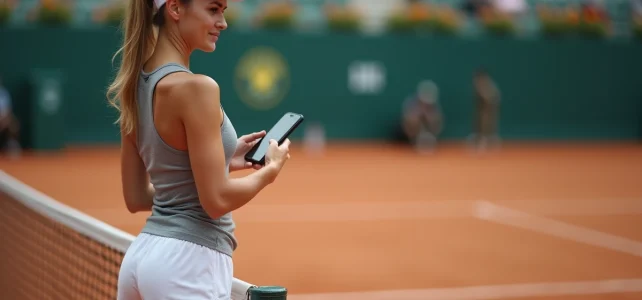
Aryna Sabalenka, world number one in the WTA rankings, posted a series of topless photos on her Instagram account that generated millions of interactions within hours. The term “Sabalenka topless” immediately surged in search trends, fueling debates and articles in the international sports press.
Aryna Sabalenka’s Instagram Strategy: A Deliberate Monetization Lever
These posts are part of a precise mechanism, far from improvisation. In an interview with Forbes Russia at the end of 2024, Sabalenka explained that her team closely monitors her social media statistics and that some bolder shoots are part of a strategy to monetize her audience. Fashion sponsors, beauty partnerships, collaborations outside of tennis: the player’s Instagram profile functions as a full-fledged commercial showcase.
Related reading : The phenomenon of celebrity couples with a significant age gap: their view of love defies social norms
Sabalenka emphasized a specific point: “every public photo is a calculated choice.” The content is not spontaneous. It goes through validation, an editorial calendar, and an analysis of the fallout. The buzz around the topless images of Aryna Sabalenka fits into this logic of personal branding, not that of impulsive provocation.
The distinction matters. An athlete who controls her image and chooses to stage it does not suffer from media scrutiny: she directs it.
See also : White Background Photos: The Secret to Successful Sales on Amazon and Other Marketplaces?
Sabalenka and the Sexualization in Sports Media: What She Says
Posing topless and refusing to be reduced to her physique fall into two different registers. During the US Open 2023, in an interview published by The Guardian, Sabalenka stated that she wanted to be judged “on her tennis and her work,” expressing discomfort with headlines too focused on the bodies of female players.
This position does not contradict the photos published on Instagram. It draws a line between two distinct situations:
- The content chosen by the athlete herself, on her own channels, according to her own terms. The player decides the framing, the message, the timing of publication.
- The media treatment endured, where editorial teams select a bodily angle to generate clicks, without the athlete having a say in the editorial context.
- Unsolicited comments on a player’s physique during a match or press conference, which fall under a completely different dynamic than a controlled professional shoot.
Sabalenka claims the right to control the staging of her own body while refusing to let others do it for her. This position is coherent, even if it confuses some of the public.
Social Media and Women’s Tennis: The Mechanics of Engagement
Sabalenka’s posts are not an isolated case. Women’s tennis occupies a unique place in the economy of sports social media. Top 10 players often generate a higher engagement rate per post than their male counterparts, and lifestyle or fashion content represents a significant share of their total interactions.
Several factors contribute to this phenomenon:
- The algorithms of Instagram and TikTok favor visually emotional content, whether positive or negative. A topless shot mechanically triggers more comments than a match summary.
- Non-sports brands (cosmetics, luxury, lifestyle) seek ambassadors capable of reaching an audience beyond tennis fans. A profile that mixes athletic performance and fashion content becomes a versatile advertising platform.
- The virality of a bold post also benefits sports results: spikes in followers related to a buzz translate into increased visibility during tournaments.
Polarizing content indirectly finances the sports career. Revenues from off-court partnerships regularly exceed prize money for players who are well-positioned on social media.

Topless Photos of Sabalenka: What Was Actually Published
The media coverage surrounding these photos often exaggerated their provocative nature. The images published by Sabalenka are part of a carefully crafted professional shoot, with controlled lighting, framing that shows nothing explicit, and an aesthetic similar to what is found in the fashion pages of high-end magazines.
No frontal nudity appears in the posts. The poses use shadow play, props, or arm positioning to suggest without showing. This type of content is common in the fashion world and does not violate Instagram’s moderation rules.
The disproportionate reaction from some sports media is more about a headline reflex than the actual nature of the images. The word “topless” in a title generates clicks, regardless of the actual content of the post. The loop is simple: an athlete publishes controlled content, media frame it with sensationalist vocabulary, the public reacts more to the title than to the photo, and engagement rises for everyone.
The Role of Platforms in Amplification
Social platforms have recently tightened their moderation policies around bodily content, but Sabalenka’s posts have faced no restrictions. This confirms that the content complies with the terms of use and that the “scandal” is manufactured by the media layer, not by the images themselves.
Sabalenka masters an exercise that few athletes succeed in: turning an Instagram post into a global media event without ever losing control of the narrative. The controversy benefits her personal brand while remaining within a framework she has defined. The buzz will fade, but the followers gained and contracts signed during this visibility window will have effects long beyond the media cycle.