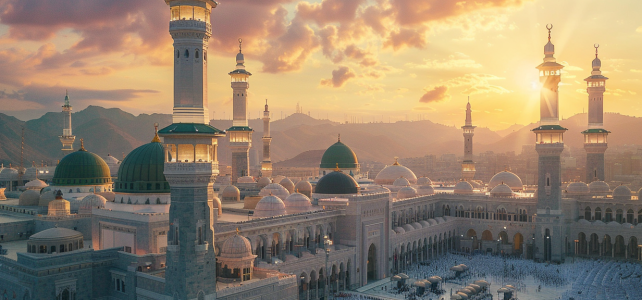
Mecca, the sacred city for Muslims, remains a place filled with mystery and devotion. Every year, millions of faithful converge on this city in Saudi Arabia to perform the Hajj, one of the pillars of Islam. The spiritual and geographical heart of the Muslim religion, the Kaaba, this black-draped cubic structure, stands at the center of the Great Mosque of Mecca. It evokes deep veneration and is surrounded by numerous traditions and narratives. Beyond its religious dimension, Mecca is also a historical and cultural crossroads whose ancient and contemporary history is often unknown to the general public.
Mecca through history: from foundation to modern city
Where is Mecca, this geographical and spiritual enigma, located in the heart of the Arabian Peninsula, in a basin of Asir, near the solidified lava chaos, the harrat, which characterize the landscape of Hijaz. This city, which rises about 84 kilometers from the Red Sea, is surrounded by mountains that separate it from the rest of the world, creating a natural sanctuary, a place apart, where history and spirituality meet. Over the centuries, Mecca has seen its fate closely linked to that of the Hijaz region, known for its rugged terrain and rich history, marked by the presence of the Sassanian Persian Empire before the advent of Islam.
Read also : The Hidden Secrets of Beauty Salons in Paris
The holy city of Mecca has traversed the ages, from its mythical foundation by Abraham and Ishmael to its transformation into an undisputed center of Muslim religious life. At the edges of empires, far from the centers of power in Syria-Palestine and Yemen, it nevertheless welcomed caravans and merchants, forging a reputation as a crossroads of trade and cultural exchange. The rise of Islam, with the prophetic revelation to Muhammad, propelled this city located in the western part of the Arabian Peninsula onto the world stage as a place of pilgrimage and annual gathering of the faithful.
Modernity has not spared Mecca, which has managed to reinvent itself while preserving its ancestral heritage. Skyscrapers and contemporary infrastructure now coexist with historical sites and religious monuments, reflecting a balance between progress and tradition. This metamorphosis, often a subject of debate, reflects the complexity of a city that must manage the massive influx of pilgrims from around the world. Mecca thus remains a strong symbol of the universality of Islam while being rooted in the realities of a constantly evolving world.
Read also : Mastering the calculation of portage with precision
Mecca, the spiritual heart of Islam: rites and meanings
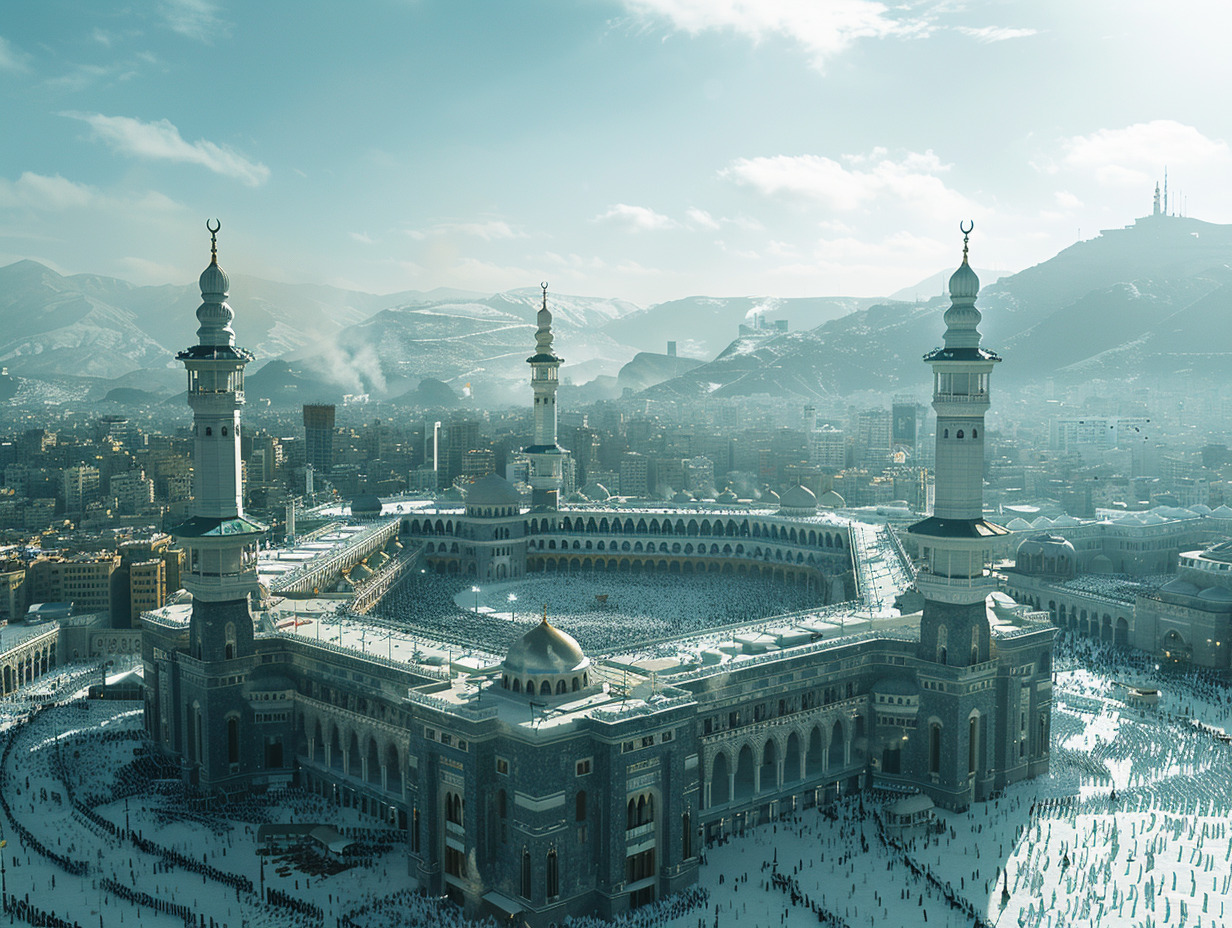
The spiritual heart of Islam beats within Mecca, a city built in a basin of Asir, not far from the tumult of the Red Sea. The sacred dimension of the city fully reveals itself through the pilgrimage, the Hajj, one of the five pillars of Islam, which attracts millions of faithful each year. The Kaaba, a black-draped cubic structure, serves as the epicenter of the rite. Around it, pilgrims perform the circumambulation, or Tawaf, in a quest for spiritual elevation, thus recreating the ancestral gesture of Abraham, the tutelary figure of monotheisms.
The Muslim rites practiced in Mecca embody more than mere devotion. They symbolize a return to the roots of faith, a communion in effort and humility, in this geography that is alternately welcoming and austere, between harrat and mountain peaks. Mecca, located in the west of the Arabian Peninsula, stands out not only for its geography but also for the depth of the religious meanings associated with it. Every gesture and every prayer recited refers to a symbolic richness, to a history shared by the global Muslim community, the Ummah.
The transformations of Mecca, balancing between modernity and heritage preservation, do not diminish the vitality of these ancient practices. On the contrary, the city continues to adapt and evolve to maintain its role as a spiritual beacon. The Kaaba, toward which the prayers of Muslims around the world are directed, remains the anchor point of a living and dynamic Islam, reflecting the diversity and unity of its followers. Mecca, through its rites and meanings, remains the symbol of a faith in perpetual renewal, faithful to prophetic teachings, and open to the horizon of modern times.