
Speaking at your son’s wedding means condensing years of shared life into a few minutes. The speech for your son’s wedding isn’t just a series of childhood memories: it symbolizes a gesture in front of the assembly, that of a parent publicly acknowledging the couple that their child has now become a part of.
The trap of generic speeches and how to avoid it
Most templates available online offer an identical framework: touching memory, compliment to the daughter-in-law, wishes for happiness. The result often sounds hollow because these texts could apply to any family.
Recommended read : How to Read Your Payslip Effectively: Analysis and Practical Tips
A good speech is based on a simple principle: every sentence must be impossible to recycle for another wedding. If you can replace your son’s name with that of a stranger and the text still works, it lacks substance.
Before you start writing, note three specific moments you shared with your son. Not categories (“his childhood,” “his studies”), but scenes with a location, an approximate date, a sensory detail. It is this raw material that will give the speech its uniqueness. Writing a speech for your son’s wedding gains authenticity when you start from these micro-memories rather than from ready-made formulas.
You may also like : Tips and Tricks to Support Your Child's Development and Growth

Structure of a wedding speech for your son: three effective blocks
Forget the school structure of introduction/development/conclusion. An oral speech follows a different rhythm. Here’s a breakdown tested by officiants of secular ceremonies, which consists of three unequal blocks.
Block 1: anchoring through a scene
Open with a unique anecdote, told in four or five sentences maximum. A concrete scene captures attention better than an abstract declaration of love. Describe what you saw, heard, and felt at that moment.
Example: “The day you brought home your first report card with a zero in dictation, you looked at me and said: ‘Dad, words aren’t my thing.’ Twenty years later, you’re writing your own wedding vows.”
Block 2: acknowledging the couple
This section is often rushed. Parents talk at length about their son, then add a polite sentence about the daughter-in-law. Address the couple directly, not just your child.
Name a specific character trait you have observed in your daughter-in-law or son-in-law. Share a moment when you realized that this person truly mattered to your son. This explicit acknowledgment of the couple, and not just the biological child, holds particular importance in blended families.
Block 3: passing on
Conclude with something you wish to pass on: a value, a piece of advice drawn from your own experience as a couple, or simply a phrase that your own parents told you. This block should remain short, two or three sentences at most.
Writing an emotional speech without falling into pathos
Emotion cannot be decreed. Repeating “I am moved” or “this is the most beautiful day” has the opposite effect: the audience disengages. Emotion arises from the concrete.
- Prefer action verbs to adjectives: “you taught me patience” is better than “you are a wonderful son”
- Limit your speech to two or three developed memories rather than ten skimmed over, as each anecdote needs details to resonate
- If you mention challenges faced together (illness, difficult times, grief), psychologist and family therapist Fanny Marais notes that these references to recent family crises make speeches more vulnerable but also more impactful for the audience
- Use short sentences with pauses. An oral speech is not a literary text: silences carry as much weight as words
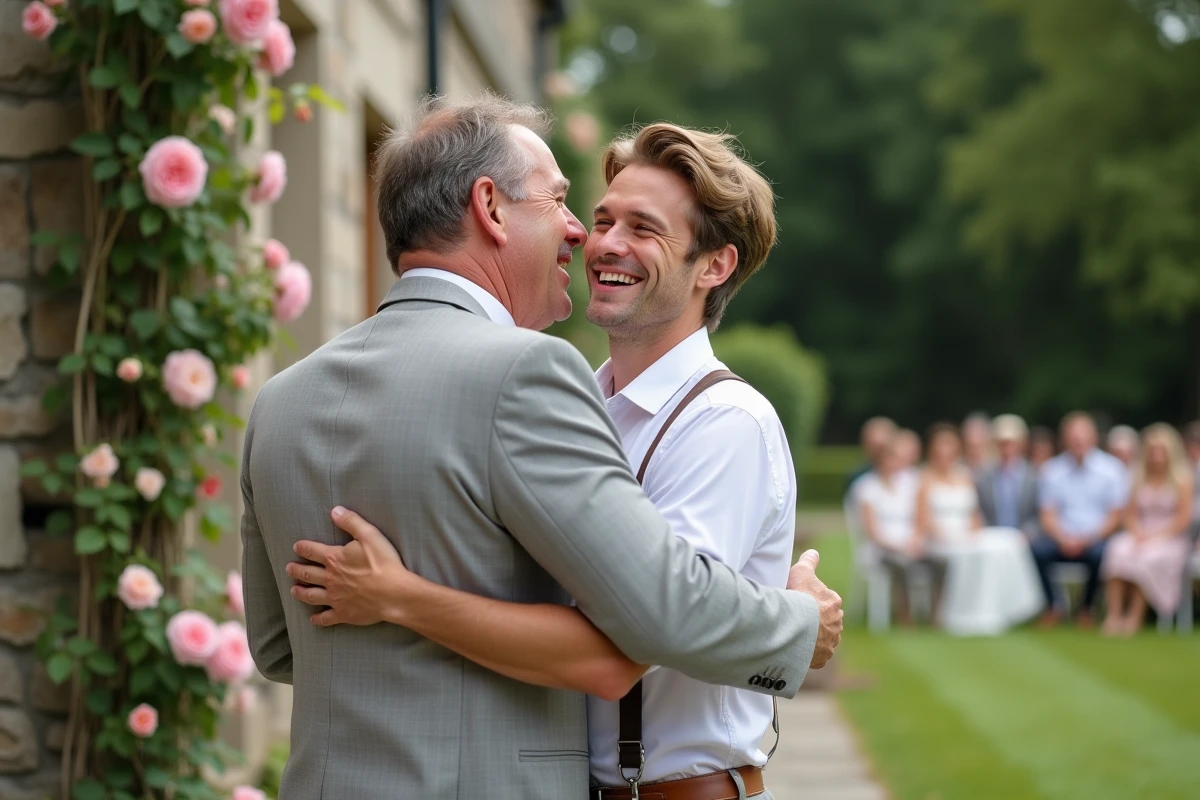
Co-written speech with your son: a game-changing trend
In recent years, wedding planners and speaking coaches have observed a rise in “co-written” speeches. The principle: the son briefly intervenes in the middle of his father’s or mother’s speech to respond or share a common anecdote.
This format has two concrete advantages. First, the dialogue between parent and child creates an emotion that a monologue cannot reach. The audience witnesses a real exchange, not a reading. Secondly, the parent shares the nerves with their child, which reduces the pressure of speaking alone in front of the assembly.
For this format to work, plan the transition moments together. A discreet signal (a keyword, a gesture) allows the son to take over without the flow seeming artificial.
Preparing for the reading aloud: the detail that changes everything
A beautiful text on paper can sound flat when spoken. Practice your speech at least three times aloud before the big day. Identify the passages where your voice might crack and decide in advance whether to pause or continue.
- Print the text in large font, with breathing marks between paragraphs
- Time yourself: the ideal duration is between two and four minutes; beyond that, attention wanes
- Consider the video rendering: short sentences, clear pauses, and a clear concluding statement make editing easier for the wedding videographer
You don’t need to memorize every word. Knowing the structure by heart and having your sheet in hand is enough. Being natural is always better than performing.
The speech that will be remembered is never the one that tries to please everyone. It’s the one where a parent says something true, in their own words, at a moment when the whole family is listening.